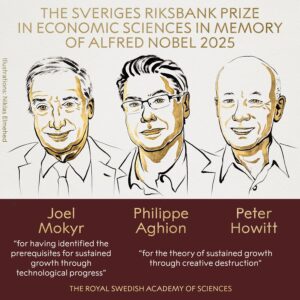
2025 Nobel Prize in Physics Awarded for Discovering Quantum Effects in Circuits
The 2025 Nobel Prize in Physics has been awarded to John Clarke, Michel H. Devoret, and John M. Martinis for their pioneering work showing how quantum effects can appear in ordinary electrical circuits. Their experiments bridge the gap between the microscopic quantum world and the visible world around us.
Usually, quantum physics describes very small particles like electrons or atoms. However, these scientists proved that even larger systems, such as superconducting circuits, can follow quantum laws. They used a special device called a Josephson junction — two superconductors separated by a thin insulating layer — to show two amazing quantum effects: quantum tunnelling and energy quantisation.
In their experiments, they observed that the electric current could “tunnel” through an energy barrier, something that is impossible in classical physics. They also found that the circuit could only absorb or emit fixed packets of energy, just like electrons in atoms do. These findings confirmed that quantum mechanics applies to much larger systems than scientists once believed.
Their discoveries have become the foundation for quantum computing and advanced sensing technologies. The ability to control quantum states in circuits is what makes quantum bits (qubits) work — the basic units of quantum computers.
This year’s Nobel Prize reminds us how the mysterious rules of quantum physics are not limited to atoms but can also shape the devices of our future, leading to faster computers and new scientific breakthroughs.