The 2025 Nobel Prize in Chemistry: Building Molecular Frameworks with Big Pores
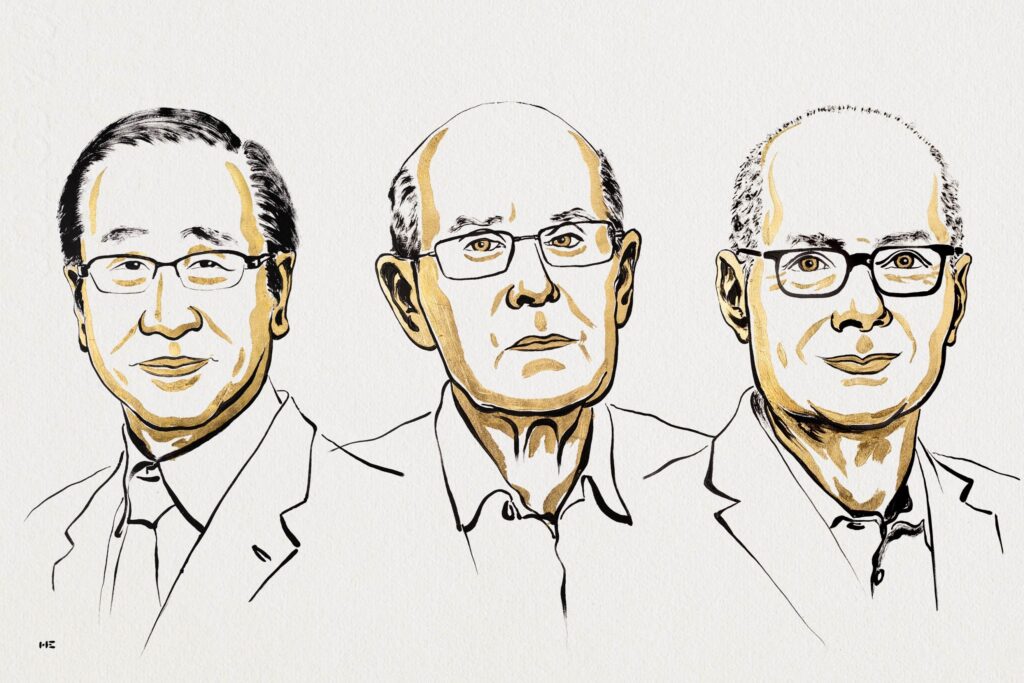
In 2025, the Nobel Prize in Chemistry was awarded to Susumu Kitagawa, Richard Robson, and Omar Yaghi for their work in creating metal–organic frameworks (MOFs).
Their achievement lies in inventing molecular structures with large internal spaces—like tiny cages—through which gases and chemicals can freely pass. These frameworks combine metal ions (acting as “cornerstones”) with long organic (carbon-based) linkers to build crystals full of cavities.
Because the building blocks can be varied, chemists can design MOFs tailored for specific tasks. Some MOFs can capture carbon dioxide, store dangerous gases, harvest water from arid air, or help speed up chemical reactions (catalysis).
The idea began in 1989 when Robson experimented with combining copper ions and a four-armed molecule to form a spacious crystal. But that early structure was weak and collapsed easily. Over later years, Kitagawa and Yaghi strengthened the approach. Kitagawa showed gases could flow in and out and predicted flexible MOFs. Yaghi made highly stable frameworks and demonstrated how to design new functions into them.
Thanks to their pioneering work, scientists have now created tens of thousands of MOFs. These materials hold promise in solving pressing challenges: capturing pollutants, filtering water, and enabling more efficient chemical processes.
The 2025 Prize money of 11 million Swedish kronor will be divided equally among the three laureates.