Explained for Students: How Three Scientists Showed Quantum Tricks in an Electric Circuit — 2025 Physics Nobel
The Nobel Prize in Physics awarded to John Clarke, Michel H. Devoret, and John M. Martinis for their experiments that brought quantum behavior into a system you can nearly hold in your hand. Their research helps us understand the boundary between everyday classical physics and the strange world of quantum mechanics.
What Did They Discover?
Quantum mechanics usually governs very tiny things — atoms, electrons, photons. But their experiments used electrical circuits made of superconductors connected by a thin insulating layer, called a Josephson junction.
In this setup, they demonstrated two key quantum effects at a larger scale:
- Quantum Tunnelling — the system “tunnels” through an energy barrier even when classical physics says it cannot.
- Energy Quantisation — current or voltage in the circuit changes only in fixed “steps” or amounts of energy, not continuously.
Their circuits were macroscopic (big compared to atoms), yet showed those quantum features, meaning quantum rules can operate beyond the microscopic.
Why This Is Important
- Bridging Two Worlds
Their work shows quantum effects don’t vanish just because the system is large. This helps scientists understand at what scale quantum rules change to classical ones. - Quantum Technology & Computers
To build quantum computers, scientists need to control quantum states in circuits. Their discoveries directly support how quantum bits (qubits) might work in real devices. - Better Sensors & Communications
Knowing how to control energy levels and tunnelling may help design ultra-sensitive detectors (for example, measuring magnetic fields) and more secure communications using quantum properties.
How the Science Works (Simplified)
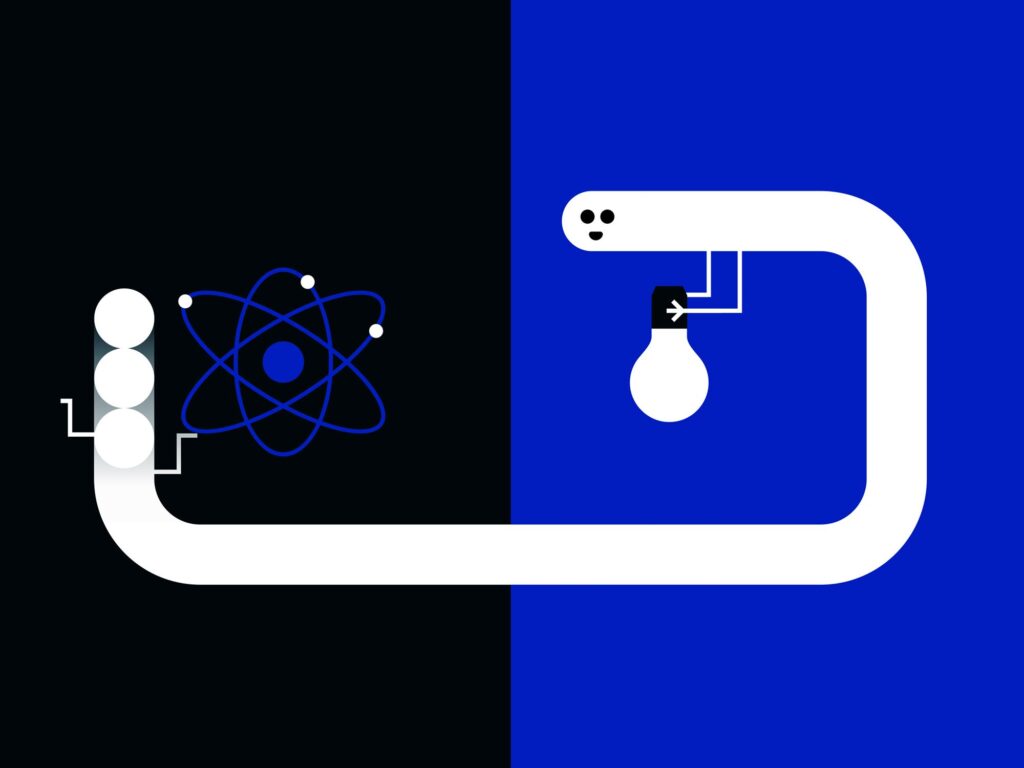
Imagine the circuit as a marble trapped in a bowl (no voltage state). Classical physics says marble can’t cross over a wall (energy barrier). But because of quantum tunnelling, it sometimes “tunnels” through the barrier to the other side, even without going over it. That’s the first quantum effect.
Then, once it changes its state, it can only absorb or release energy in fixed packets — not gradually. That’s energy quantisation.
In sum, these physicists proved that quantum weirdness works even in circuits far larger than atoms — a big step toward real-world quantum machines.
The 2025 Nobel in Physics honours this bold work at the intersection of theory and experiment. For high school students, it’s an inspiring example: the strange rules of the quantum world are not just for textbooks — they are shaping technologies of the future.