Why Innovation Wins: 2025 Nobel in Economic Sciences Awarded for Growth Theory
The 2025 Nobel Prize in Economic Sciences has been awarded to Joel Mokyr, Philippe Aghion, and Peter Howitt “for having explained innovation-driven economic growth.” The prize amount — 11 million Swedish kronor — is split with one half going to Mokyr and the other half to Aghion and Howitt together.
Over human history, sustained growth was rare. For long periods, economies would stagnate — only occasional discoveries would temporarily raise incomes. But in the modern era, some nations have achieved continuous growth, lifting millions out of poverty. The Nobel committee says the laureates’ work helps us understand how that became possible.
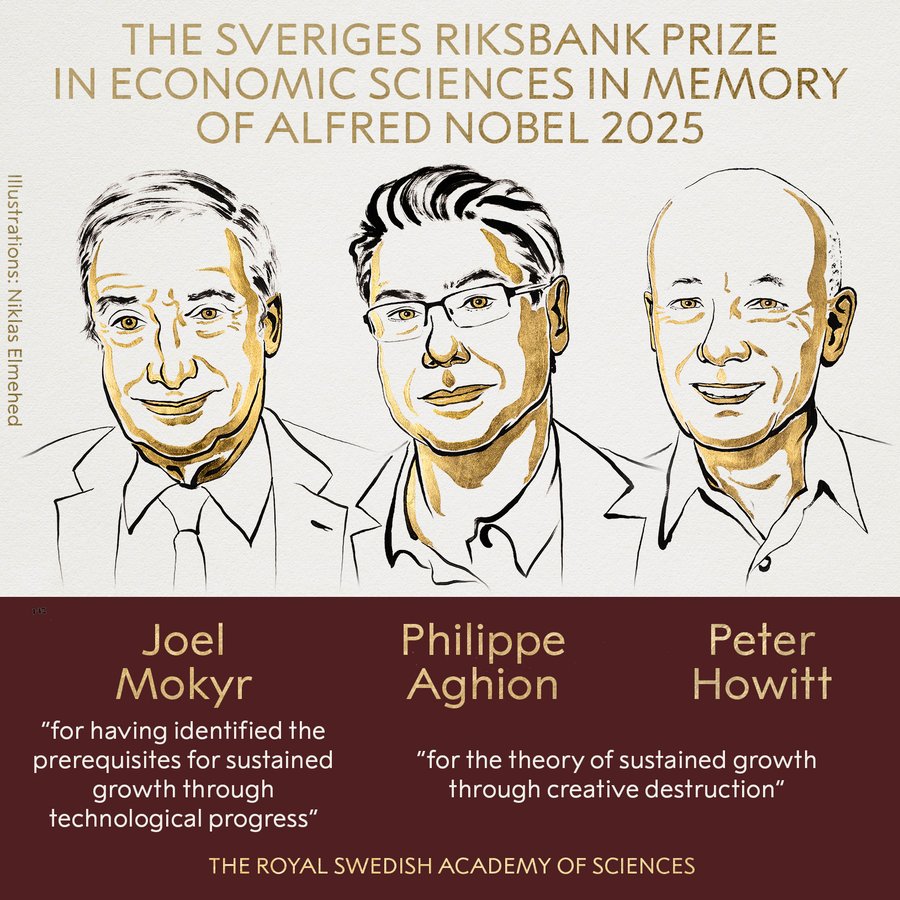
Mokyr explored how knowledge, explanation, and openness to ideas made innovation build upon innovation. He argued that it’s not enough to discover new methods — societies must also have theories and systems that allow discoveries to be improved and adopted. He emphasizes that innovation requires social freedom and intellectual openness.
Meanwhile, Aghion and Howitt developed models of “creative destruction”. Their idea is that new, better technologies replace old ones, generating growth — but also creating conflict and resistance from entrenched interests. Their models show how these tensions must be managed so innovation can flourish without harming stability.
Together, their work offers a roadmap for policy: encourage research, open markets, resist monopolies, protect new entrants, and maintain systems that let change happen. The Nobel committee warns that economic growth is not guaranteed — we must preserve the forces that allow innovation to drive progress, or we risk stagnation again.
For Pune and India, the message is strong: to sustain growth, we must foster education, technological investment, open competition, and institutions that support new ideas. In a fast-changing world, innovation is not optional — it is essential.